A horizontal disc rotates freely about a vertical axis through its centre. A ring, having the same mass and radius as the disc, is now gently placed on the disc. After some time, the two rotate with a common angular velocity.
Text Solution
Verified by ExpertsCHECK THE SOLUTION.
(a, b, d)
Let ω ω 1 = the initial angular velocity of the disc. ω ω 2 = the final common angular velocity of the disc and the ring. For the disc, I 1 = 1/2 mr 2 .
For the ring, I 2 = mr 2 .
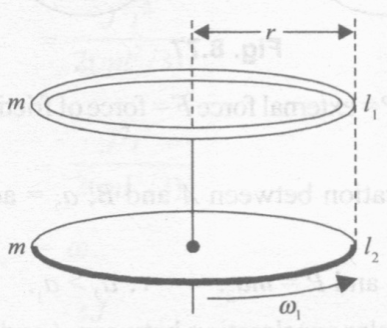
By conservation of angular momentum
L = I 1 ω ω 1 = (I 1 + I 2 ) ω ω 2 or ω ω 2 =  .
.
Initial kinetic energy = E 1 =  I 1 ω ω 1 2 .
Final kinetic energy = E 2 =  (I 1 + I 2 ) ω ω 2 2 .
Heat produced = loss is kinetic energy = E 1 – E 2 .
Ratio of heat produced to initial kinetic energy
=  .
.
Prepare Smarter with CGP Edu
Get practice questions, solutions, and test series in one place.
Write a Review
Share your experience with this question and solution.
Commentary
Send your comment, doubt, correction, or feedback to admin.
Similar Questions
Explore conceptually related problems